Sunday, June 22, 2014

Aymara New Year (GRAPHIC CONTENT)


June 21st is the Aymara New Year, which I decided to attend. The Aymara are one of the 38 ethnic groups that make up Bolivia, and the current president of Bolivia, Evo Morales, is said to be part Aymara himself. The Aymara people make up more than 25% of Bolivia’s population, and in more recent years they have been gaining more political power – part of the reason their new year celebration has been declared a national holiday. One of the notable historic skills acquired by the Aymara people is their knowledge of astrology, and June 21st is celebrated because it marks the Southern Hemisphere’s winter solstice, when the sun is at it’s furthest point from the the equator. On that day the harvest period ends and a new agricultural cycle begins. This makes June 21st simultaneously the shortest day and longest night of the year in this part of the world.

The tradition holds that the night before the sun rise the Aymara people get together and hold a vigil throughout the night, keeping themselves awake until the sun’s first rays rise above the ruins or the mountain where the celebration is taking place. Therefore, on the evening of June 20th I got into a minibus along with a group of a dozen or so other people and started the 4 hour drive (130 kilometers east of Cochabamba) to the ancient ruins of Inkallajta.

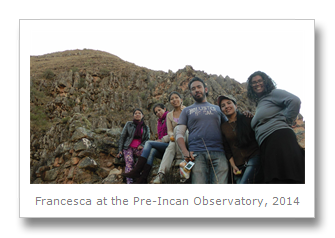
The ruin of Inkallajta was one of the last places of Inca military expansion towards the east of Bolivia. While there are many clearly Incan structures present (there are typically Incan niches in the Kayarani or main building) there was also a pre-Incan astronomical observatory at the site indicating that the Incans were not the first people to establish themselves in this area, and that it was indeed a takeover from a previous culture. But more about the ruins in the morning when we have some light! Back to that evening…

Once we arrived at the festival, we got our blankets and cooking supplies out of the car and walked towards the giant plume of smoke we saw ahead in the distance. Once we reached the celebration we set ourselves around one of the bonfires. The group's cook made us hot dogs with ketchup on them, along with hot drinks throughout the evening. There was even a bit of whiskey being passed around. One of the guides pulled me up from the fire and brought me to the dancing circle which had formed around the band playing charangos. He taught me the local dances and we had a lot of fun while waiting for the sun to come up.



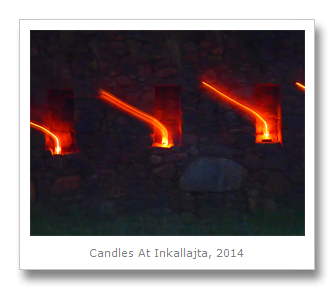
The hours passed and the drinking and dancing went on. Soon it was time for the sun and we gathered up all our stuff and climbed the nearby mountain in near darkness until we reached the ruins. We couldn't see neither the ruins nor the mountains and views around us yet, but there was a beautiful eerie magic about the place. There were candles burning in the little archways of the ruins, letting us have a glimpse of their outline before the sun came. I took some photos of this stunning sight.   


Once the sun started rising and we could see a bit more, the speeches began. Various Bolivian diplomats said a few words (that no one seemed to pay attention to) and then came the coca leaves and the alcohol, which were handed out to the diplomats to chew and drink.

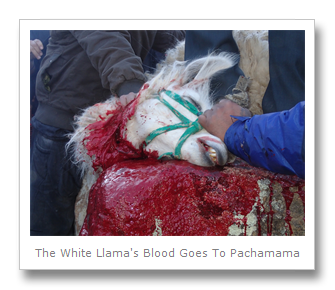
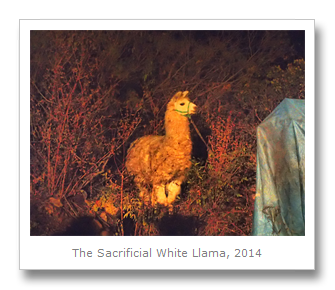
There was suddenly an announcement made - one which everyone had been waiting for. It was time for the young, white llama to become a sacrificial offering to Pachamama. We went out to a sacrificial stone (a new one, the old Incan stone was nearby but is no longer used to preserve it) – a stone that was perfectly positioned for the sun to shine its rays directly on the offering. There was a bonfire near the stone on which served as a ‘table of offerings,’ to both Mother Earth, Pachamama, and the Sun God, Inti. The young llama was brought to the offering table to have its throat cut, in order for its blood to run down the stone and into the bonfire/offering table. These collective offerings were supposed to ensure future land productivity and earthly prosperity.

Many people couldn't watch this part of the celebration, and for good reason. The following photos and videos are quite graphic, hence the warnings I put on the title of this blog post. Everyone gathered in a circle around the llama while a few men held the beast down on the rock. The leaders of the ceremony, including the shaman, took a knife and started to cut through the llama's throat, letting the blood flow down the ceremonial rock. I happened to stand in the 'perfectly' worst position possible - right in the line of fire, unfortunately. Somehow it didn't register with me (probably my lack of experience at attending sacrifices) that standing near the neck would cause me to become covered in blood from the llama's cut arteries. I took a video of the llama being cut open.

I watched as the shaman then went from cutting the llama's throat to making a cut in its' side and 'digging around' (yikes) attempting to get the llama's heart out of its' body - reading the organ gives the forecast for the following year's harvest. While trying to get the llama's heart out the llama fell off the sacrificial rock and onto the floor in front of me. A few moments later the shaman managed to get the heart, spoke some words in Aymara, and then raised the heart to the sky before throwing its' heart on the bonfire/offering table to burn for the Gods.

Just at this moment (the timing was spookily perfect) the strong rays of the sun came streaming down from the sky directly onto the fire and the stone in front of us - nearly blinding us! Everyone simultaneously raised their hands towards the sky while facing the sun's rays. A few moments later the shaman turned to me (I was clearly the only foreigner at the event, and stood out quite a lot) and dipped the tip of one of his finger in the still-dripping blood of the llama from the side of the sacrificial rock and then marked my forehead with a blessing and a smile. Not your typical touristic experience, but a memorable one. Once the ceremony was concluded the llama was brought away to be cut up and cooked, and our group walked back to the ruins.

A crucial note about the llama sacrifice: While the sacrifice of a young, live white llama is essential to the indigenous Aymara (and Incan) celebrations honoring Pachamama, the practice screams (literally, in the llama’s case) of animal cruelty. After the ceremony I decided to look up some information about animal welfare. Wikipedia’s listing about ‘cruelty to animals’ noted the ‘animal welfare position’ which supposedly states that: “…there is nothing inherently wrong with using animals for human purposes, such as food, clothing, entertainment, and research, but that it should be done in a humane way that minimizes unnecessary pain and suffering.”  There is another school of thought which asks for animal rights, in other words, for animals to never be considered property or used for commercial purposes.

Another website I came across was the American Veterinary Medical Association’s article ‘What is animal welfare?’ Their article gives a bullet point list which includes that animals:

  • … [are used responsibly] for human purposes, such as companionship, food, fiber, recreation, work, education, exhibition, and research conducted for the benefit of both humans and animals.
  • … shall be treated with respect and dignity throughout their lives and, when necessary, provided a humane death.

Clearly the ceremony I attended did not give the llama a humane death, nor was the ‘human purpose’ it was used for beneficial to both the humans and the animals. So should the practice continue? In more touristic areas which conduct a June solstice ceremony such as at the Tiwanaku (Aymara) ruins in La Paz or the Sacsayhuaman (Incan) ruins in Peru a live llama sacrifice is no longer preformed and either a (dead) llama fetus offering is burned (as in Tiwanaku) or the llama sacrifice is only ‘acted out’ instead (as in Sacsayhuaman.) Since I was the only tourist at the Inkallajta (Incan) ruins, the area is clearly not a main touristic site yet and does not attract enough attention from foreigners that a live llama sacrifice might be detrimental to attendance or Bolivia’s reputation. I saw a few locals cringe and turn away during the llama sacrifice, but no sign of any Bolivians protesting the act.

One must also consider the rights of indigenous communities to continue their traditions and practices. Does this method of sacrificing a llama become more ‘OK’ because it has been practiced by the pre-Incan and Incan people for thousands of years? Do they have a right to continue the sacrifice because of this? Or is this just a practice which is outdated and (with new thoughts on animal welfare/rights) should be considered selfish and inhumane on the part of the participants? Certainly other indigenous practices (such as human sacrifice and body mutilation) performed by both indigenous Bolivians and tribes in other countries are considered too inhumane to be allowed to continue, despite their status as part of the ‘local indigenous traditions and practices.’

If this is considered to be the case at Inkallajta, is there another way tradition can be honored while increasing standards of decency and respect towards animals? Clearly at Tiwanaku and Sacsayhuaman this thought has already been considered and an alternative reached. But what will happen at Inkallajta as the area around Cochabamba becomes ever more touristic? We’ll have to see…                   

 
WARNING GRAPHIC CONTENT OF AN ANIMAL BEING KILLED
 

It was time for us to take a walk around the Incan ruins.

Inkallajta is a well-preserved Incan stone fortress and administrative area of 67 hectares built in the mid 1400’s, likely during the rule of Tupa Inca Yupanqui. Compared to Tiwanaku or Machu Picchu, where many people go to celebrate the Aymara New Year, this sight is actually much better preserved though smaller.

Yet smaller is relative, because the site has forty buildings including: a ‘Kallanka’ or main hall with numerous, typically Incan niches. Also a Pre-Incan astronomical observatory, religious rooms, military barracks, university rooms (for the housing of students and teachers) and a waterfall with a microclimate around it known as Pajcha, or the ‘Waterfall of the Virgins’ because the Incan virgins supposedly bathed there. There was also a large, strategically placed house of unknown purpose nearby. I reckon it was likely the mansion of an Incan noblemen, as it had a perfect view of  the virgin bathing site. My favorite aspect of the ruins was a series of defensive walls above a high valley which had strategically shaped windows from which it was easy to fire out without being fired back at. Overall I was really impressed by these ruins – they and their history should definitely get more attention from tourists! 

The history of the Incans in the region went like this:    

“Once they had conquered the Collao territories, the Incas marched deep into the semi-tropical valleys of what now are the Cochabamba and Santa Cruz states. There, they established a series of cities, specially fortified to control the advances of the Chiriguano indians. The Incas created… in the state of Cochabamba… the fortified city of Incallajta.” (World Heritage Organization)

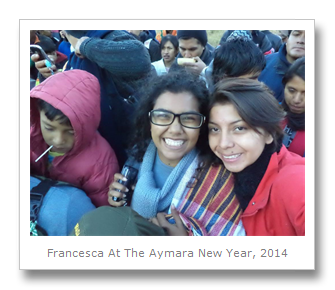
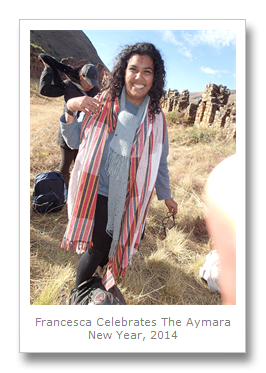
My camera died but through the help of some of my new friends I met at the event I was able to get some photos of myself at the ruins anyways!

Our exploration of the ruins finished, we gathered in the center of the Kallanka and had a delicious cooked lunch the guide had prepared while we were on our tour of the ruins. Once the dog roaming around us had managed to snag the leftover meat we were all ready to head back. We gathered our stuff together and walked towards the festival location from the night before where the car and driver were waiting. When we found our driver he looked pretty tired. Really tired. It unfortunately took getting into the car with him for the short ride to where the rest of our group was waiting for us to figure out that he was completely drunk! As we drove towards our group some members near the road started waving their hands and yelling at the driver to stop. He was too wasted to stop quickly enough and ran over the cooking pot and its stand.

Clearly this was not good and our group decided we were not going to go any further in the car with this guy. The driver got angry we weren’t coming in the car and sped off- good riddance- and we waited for our guide to find another ride for us. Most of the other tour groups and buses had already left the celebration earlier that morning so we were a bit stuck. It took our guide 4 hours (we were just talking on the side of the road during this time, and watching the drunk Bolivians fall on their asses around us) to find another minibus for us to take to get back to Cochabamba.

The new minibus driver (who I believe was also drunk, but less drunk than our first driver) sped like an absolutely madman to get back to the city, sometimes nearly 50 or 60 kilometers over the posted speed limit (if there was any, which there often wasn’t.) I had to ask the driver to slow down (he didn’t listen to my request until I asked a *male* to ask him for me, and then he only slowed down a little) because myself and two Bolivian girls in the backseat were nearly having heart attacks at how fast he was driving. When we got back to Cocha it took me awhile to find the hotel, but eventually found Colin there asking the front desk to phone the tour agency to try to find me. We ended up being quite a few hours late, so I’m not surprised that he started to worry. But now I was back with llama blood all over our backpack and quite a story to tell!            

Francesca

Sunday, June 15, 2014

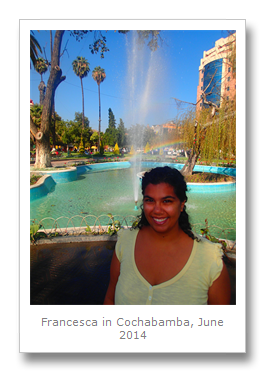
Cochabamba


Bolivia’s fourth largest city was a move back up towards the high Andes for us after spending so long in the Eastern lowlands around Santa Cruz. At 2558 meters above sea level, Cochabamba was also known as The Garden City due to its year-round clement weather. We were on a bit of a deadline to see the last cities in Bolivia because we had to get to the Inca Trail in Peru within the next month! However, we found time to fit in the things that we wanted to see.

We asked at the Cochabamba tourist information office about the two nearby National Parks we wanted to see, and we were encouraged to make the journeys independently of a tour agency, and make the trips ourselves. We found this to be pretty good advice.

We next went to the Santa Teresa Convent, but they told us they only had English tours later in the day. They refused to give us a discount for having no English speaking guides available, and it was quite expensive, so we agreed with them to come back at 4pm. We then tried the Portales Palace which was across town so we tried to take a taxi. Three taxi drivers had no idea where the palace was, even though it is now a cultural center and a major tourist attraction. This was our first red flag that actually, Cochabamba was far from the tourist trail, and not many people bother going there.

We eventually got to the palace, which was built by Simon Patiño, a wealthy mining magnate who rose from poverty to riches quite by accident. He worked as a debt collector for a mining store, and decided to settle a debt for a piece of land on the side of a mountain. He was fired for this piece of individualistic thinking, and forced to pay back the debt himself. He acquired the land, and quite by accident discovered large deposits of tin there. When he died in 1947 he was one of the fifth richest men in the world.

Unfortunately, the opening hours were all wrong online, as is often the case in South America where websites are rarely kept updated, if working at all. The palace was closed, so we headed back into town.

We found one museum that was open; the anthropology museum. Split into different sections, from pre-history, through the different cultures in the region, there were some really interesting pieces there. My favorite was some Jesuit papers that showed how they used a language created with stick figures (as the indigenous did not have written language) to teach the natives the stories from the bible.

After learning about how the agricultural indigenous were replaced by the more administrative and warlike Incans, our semi-disappointing day took a turn for the worse.

We had some lunch and headed down to Cochabamba’s famous marketplace. We had a big shopping list, and this huge sprawling market was supposed to be able to cater to all needs. This was our second big disappointment of the day, as about ten minutes after we arrived, a dirty Bolivian thief spat on the back of my head! This is a known tactic we had read about, and as I turned around, distracted, three men began to surround me. I knew what was coming, but the men did not. Francesca bowled into them like a bowling ball, and they all disappeared quickly down prearranged routes of escape. I noticed the market sellers were looking on in amusement at a scene I think they have seen play out a hundred times. I think they are colluding with the criminals in that case, and are no better than they are. Scumbags.

La Cancha Market is definitely NOT safe – DO NOT GO THERE! Francesca’s heroic efforts probably ensured I did not get a knife pulled on me, which is apparently what normally happens. We got out of the market, quickly and directly, and never went back. The would-be muggers did not succeed in getting anything, mostly because they did not recognize that we were together and so did not see Francesca watching all of their moves like a hawk! That is why she is my hero, and everyone should admire her courage and bravery. Thanks baby x.

After that near disaster, which could have been a lot worse, we walked down to a nearby local artistic center. The walk was very nervy, as the Southern part of Cochabamba is not a recommended place to be, especially after a near-mugging. When we arrived, we wanted to just walk around, but were told to wait for the director. We waited for ten minutes, but we realized that it was time to head back to the convent for our tour, and the art center looked pretty bleak and uninteresting anyway. I think the reason they have you guided round is to solicit money from you at the end, which would have been a waste of everyone’s time.

We got back to the convent, with the taxi driver having no idea where it was. Every other car in Cocha is a taxi, and I think the country boys come to the city to make money as a driver, but have no idea where anything is at all. I showed the tax driver where the huge, un-missable convent was, and we went inside.

The woman who had told us to come back at 4pm now told us that they did not have an English speaking tour that day. Huh? This day just gets better! Francesca and I argued with the two girls there in vain, as 1) they are not used to people complaining and so did not know what to do, 2) where stupid and so did not know what to do. We left, advising them not to tell lies in the future. We never got to see the convent.
We then spent all of the rest of the day trying to book a tour for Francesca to go see the Aymara New Year festival. We visited one agency, whose website gives a wrong address. A kind man in a bookshop called them for us, and they told us they were located somewhere else. We went there, and they had literally no useful information. They told us one thing, then another, then something different from that. We walked out. Not ones to give up however, we got Francesca booked on a tour, and went back to our hotel – just another day in South America! But we survived with everything intact.

After showering the spit out of my hair (gross), we got our stuff together to go and visit one of the National Parks the very next day, because that is how we roll in the face of adversity. We were glad to be temporarily leaving Cochabamba, leaving the slightly disturbing, puffy-faced, out-of-it glue-sniffing kids (still so common in the streets of Cochabamba despite the online literature saying this is in the past) behind.

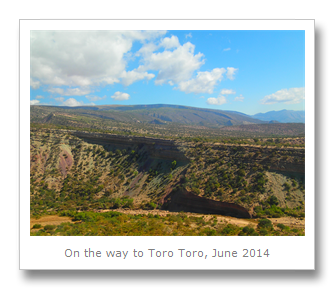
Success at last! We managed to get a trufi (shared minivan taxi) from Cochabamba to a village about 4 hours East called Toro Toro. The Toro Toro National Park is a lovely gem in Bolivia that demands about 3 days attention, which is what it got from us.

We arrived, with our fellow passengers, at the plaza, and immediately found a hotel. The rules are that you first register and pay for a five day pass, and so we did that, and then we engaged a local obligatory guide (the tourist information lady as there was no-one else at the time) to do a nice afternoon trek.

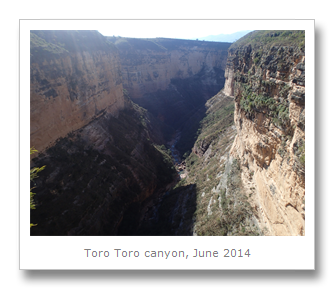
Set amid beautiful mountainous canyons with colors of red, green, and browns, Toro Toro is a really nice park to walk around and do some hiking. The landscape has been molded geologically since the Cretaceous period, with some of the land having shifted to an almost vertical position, creating really interesting formations. Much of it is covered in sparse vegetation, and the weather is mostly hot and dry.

You can choose which of the several treks you want to do, and we chose to visit El Vergel, which was a half day hike to a waterfall in a canyon, and back. Our first stop, though, was at a set of sauropod footprints, left millions of years before by a huge dinosaur. The guide tried explaining to the group how two of the footprints were actually one print, and so I had to correct her, and explain how dinosaurs walk – like elephants! Unfortunately, my learned wisdom fell on deaf ears, as the rest of the group decided not to believe Francesca and I, instead believing the clearly untrained guide, once again proving the Milgram experiment does work.

We even saw three-toed carnivore footprints, left by a medium sized dinosaur. I always love to see dinoprints, and Toro Toro has many more!

A walk down a dried up riverbed was very pleasant, and I was keeping an eye out for snakes, but did not see one. We did pass some local farmers who were using their donkeys to pound some wheat into submission though.

Soon we came to some drops in the riverbed. Old waterfalls that only flow in the rainy season. They had left their mark in the shape of some natural stone bridges that some of the group stood on. They did not look too safe to me, so I gave it a miss. In fact, after the girls in our group moved off of the bridge, I noticed it had been propped up, not so naturally, with bricks.

Bromeliads and cacti were everywhere, and we finally came upon the Toro Toro valley which had some incredible views. Large birds of prey were circling, as were the occasional parrots. This National Park is home to some endemic Macaws which do not exist anyplace else, too! I hoped to see those later.

A narrow and fairly steep set of steps led down to the canyon, over 300 in all. It was worth the descent though. Pretty flowers, clear pools of water and some huge rocks made for excellent scenery. We finally made our way down further along the canyon riverbed to a wonderful set of waterfalls. It is a magical place and a great way to spend an afternoon.

We made our way back, carefully, over slippery rocks. I could see why a guide was necessary, as, when it got dark, it would be impossible to get out of this canyon. Luckily, we all made it back safely, and we made plans to meet in the morning, to engage another guide to visit the further flung reaches of the park.

At 7am, we got together with the same girls we had travelled with, and a Bolivian couple (who later really infuriated me by dropping litter on the floor in the park – arghhh!). This was an all-day tour to Itas City and the Cave of Umajalanta. Itas was a collection of rock formations, caves and different gullies and canyons to hike through. It was located much higher than the rest of the park, at about 3500 meters above sea level, but unfortunately it was a drizzling and dreary day so we did not get to see much – and it was freezing.

There were some cool rock paintings we saw, and walking through the labyrinth of trails was nice exercise. I did like some of the cave formations we passed through, though. We had had to take a car to the ‘city’, and so we took the same car back to the trail leading to the entrance to the Umajalanta Cave.

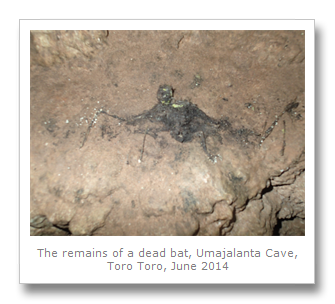
This cave is a bit of a workout, with big drops, holes and rubble everywhere. That and the toxic water found inside, and you have to be pretty careful. The cave is over 4600 meters and 164 meters deep, but a lot of it has still not been explored, as it is underwater. It is possible to go diving in the cave, but our trip was spending about 3 hours walking around a big loop.

There were some slides we had to use ropes to go down, some very narrow parts that we had to squeeze to get through, and at the end, even a small lagoon which had some endemic blind fish that we saw! Another awesome experience in Toro Toro. I liked the different rock formations and stalactites and stalagmites – and the guide showed us a part of the cave which was unfortunately covered in graffiti from the days when the locals used the cave to party in.

On our way back to the car, we saw even more dinosaur footprints of the carnivorous theropod variety. The next day, Francesca and I found our very own guide and headed off on a nice walk up to a mountaintop trail called siete vueltas. This means seven turns, referring to the trail itself, but it only takes an hour or so to get up there. Once at the top, we saw millions upon millions of small fossils, all from a time before the tectonic plates forced the land up way above sea level. These fossils were mostly shells made up of brachiopods, cephalopods and other such small marine animals. There were so many fossils all around us, everywhere, and it was our first time really fossil-hunting successfully. Of course, you are not allowed to remove any, but it is cool sifting through so many cool fossils whilst overlooking the town and valley far below.

It was such a good morning, we asked our guide to take us to another fossil zone, called the Turtle Cemetery. This involved hiring another car, which we did, and we set off to see a relatively new attraction for the park. The park is owned by the people who live there, as is often the case in Bolivia. The guides are just local people who were born in the area, into that career – they have no special training – only what they learn from books or each other. That is why the guide got the footprints wrong, I realized. They charge fees for visitors to see the land, and make it obligatory to take a guide so that the people benefit economically. It is an industry. One which I fully support as they must look after the land and it’s important findings, or suffer from a lack of tourist income. The turtle cemetery was long known about by the locals, but it took them some time before they realized that people would be interested in it as well, so it is a relatively new attraction – which made me wonder what else is out there!

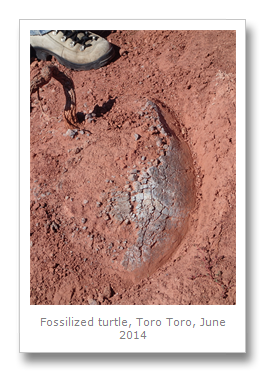
A museum with some interesting geological history was added by scientists here, and we also watched a movie our guide put on about the dinosaurs. We watched it, and then we went inside a fenced off area that was full of hilly sand dunes and rocky areas where they had found several turtles’ shell fossils. The ones that were exposed were now starting to wear down and fade, and even break up. There are probably many more, but quite rightfully, the people are leaving them be until a way can be found to show them without damaging them.

The different colored rocks and landscape were astounding in this part of the park, but we decided we would leave, and head back to town as we had one more part we wanted to see.

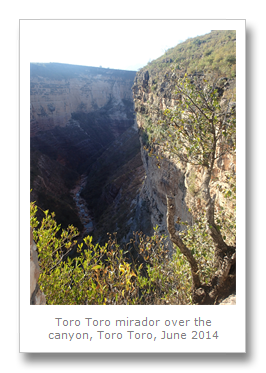
We got back to the town just in time to walk back out towards the viewpoint, or mirador, over the Toro Toro canyon. It was around 4.30pm and we waited at the viewpoint which was about 300 meters over the canyon with a walkway that jutted out over it. The reason for our wait? The rare Red-fronted Macaws that were endemic to the region. We heard there were only about 2000 living in this region, and although they have been bred in captivity successfully, this was the only place you can see them in the wild.

We waited for about an hour, and I started to think we would never see them, but at 5.30pm, almost on the dot, they started flying back to their nests in the cliff faces below, and the trees even further below. They all flew in pairs, as Macaws are monogamous and mate for life. They were magnificent in flight, with the blues, greens, yellows and the red part on top of their heads flashing through the sky!

Toro Toro was an excellent experience, one of my favorite National Parks, with lots of variety and interest! The cave was a bit difficult, but we saw people much older (and bigger) than us get through OK. On our last day, the 20th June, we even managed to fit in the museum in town, which is pretty much a showcase of the many different fossils found at siete vueltas but displayed artistically as lots of different shapes and dioramas.

We headed back to Cochabamba, and found a relatively cheap hotel to stay in, and on the 21st June, Francesca went to an Aymara New Year festival which celebrates the solstice.

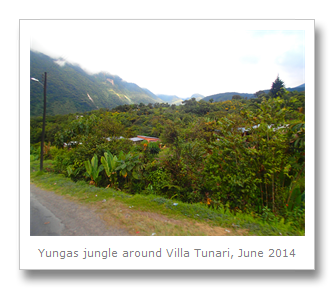
Once she came back, we had no time to waste, so we headed off to the other National Park we wanted to visit. A bus out to Villa Tunari took around five hours (almost every bus in Bolivia contains really smelly people), and when we jumped out, we found ourselves firmly in jungle territory again. Humid and full of bugs, it was pretty dark when we arrived, so we grabbed some food and went to bed in a hotel next to the Espiritu Santu River, which eventually flows into the Amazon river.

The next day we found a taxi to take us down to the entrance of Carrasco National Park. The town and the National Park are both in the region of Chapare, which is renowned for being amongst the poorest and most dangerous regions in Bolivia, particularly for people and animal trafficking, child abuse, and illegal coca growing.

On our way in, we had seen numerous big lorries carrying timber out of the jungle, and covered loads which we assumed were coca leaves. We even saw people getting on the bus with big bags of coca leaves, all of which added up to huge deforestation, which we also saw first hand too.

Our first foray into the park was relatively successful, when we went to visit the guacharos, or oilbirds that live there. Unfortunately, no one bothered to tell us that the birds fly North for the Winter (between June and August), and meet up with the other oilbirds that are from Venezuela, Columbia, Trinidad and elsewhere. Of course they do not advertise this, primarily so tourists still turn up at the National Park, even out of season. We were a little disappointed but the trail to the oilbird cave was pretty interesting anyway, and we were shown all manner of plants and trees, including ones with spikes on the trunk to stop monkeys climbing it, and others with toxic sap that could make a person very ill if they even touch it!

The trail began by crossing a wide river on a pulley system, and lasted a few hours. We saw some giant ferns, palms and bamboo trees. There was a house located in the park, to our surprise, and they had some really aggressive dogs which really should not be allowed in a National Park. We realized straight away that the chance for seeing animals here would be zero. My favorite tree we saw was the walking palm, which basically grows new roots down to the floor, and loses the old roots, and therefore seems to be ‘walking’ across the jungle floor.

We did see a huge bullet ant, an ant with an extremely poisonous bite. It is called a bullet ant, because it’s bite feels like being shot. Some locals call it the 24 hour ant, because the pain lasts that long! We made sure we stayed well away – especially because when we directed the camera lens at it, it simply reared up and got all aggressive.

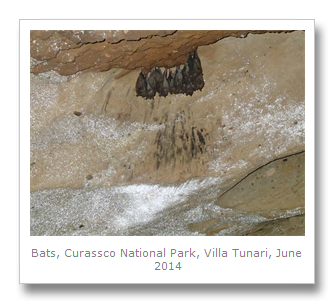
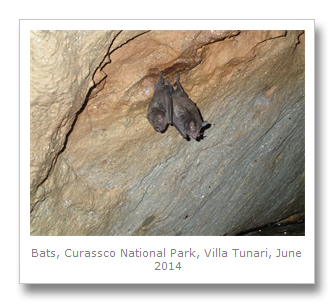
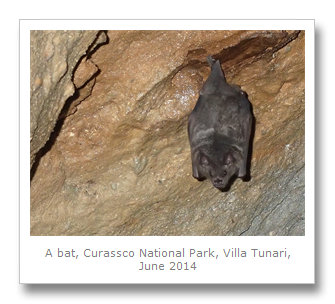
We came to a set of caves, all of which were only discovered in 1942 when they heard the sound of the oilbirds coming from within. We entered the first cave, and we saw some awesome silky short-tailed bats all clustered together hanging from the roofs right near our heads! We ventured inside and got some nice photos of them.

Outside again, and we saw some little tadpoles in a small puddle. The last stop was the oilbirds cave itself, and we were hoping to see one, as sometimes there are a few left behind that have not learnt to migrate yet. I saw lots of seeds on the cave floor, and the guide and Francesca said they saw some eyes shining at the back of the cave in the torchlight, but I did not see any of the birds. Guess we will have to wait until Venezuela where the majority of them live. The birds are called oilbirds because they used to be captured by the locals and boiled to death down into an oil! These nocturnal birds are special because they are the only nocturnal fruit-eating birds that fly, and they navigate by echolocation, much like bats! Luckily they are now protected in Carrasco, but with the onslaught of people encroaching into this park, and the governments complete lack of concern for the environment, I wonder how much longer the birds will come to this particular cave.
We had made plans with the guides for them to take us on a few more hikes either later that day or the next, but the guides were really useless and lazy – they are never at their posts and never answer their phones. My recommendation is to not go out of your way to go to Villa Tunari because a lot of the things you can see there, like giant ferns, oilbirds and the cock of the rock bird, can be seen elsewhere, in more reliable and accessible places.

We headed back to Cocha the next day, and pretty much left straight away to go to La Paz, the capital. Cochabamba is a very poor, very dangerous region, so be careful if you go there, and make sure you are not on a deadline and have plenty of time, because the people who are paid to run the tourist attractions rarely show up and hardly ever give out the correct information.