Friday, July 04, 2014

The Island Of The Sun


The trip from La Paz to our final city Copacabana was a nice trip whilst the daylight hours lasted. We even got to see Lake Titicaca, which is one of the highest lakes in the world at 3812 meters above sea level. Once the sun went down, for some reason, the driver started driving like a madman, and we also had to take a rickety wooden ferry across a part of the lake which was the most worrying part, as the bus barely fit on the damn thing.

We quickly found a cheap hostel (we only planned to stay a few days) near the plaza. Copacabana is a very touristy Bolivian town with many different activities. It is well known for the trips to the Isla del Sol (island of the sun), the trout which were introduced to the lake, and of course for Lake Titicaca, a destination I always wanted to go to as a child. The name really fires the imagination, as it was a known religious center for the Incans, and is the largest lake in South America.

Named after the sacred rock, Titikala, the lake contains the island of the sun. Many boats leave in the morning and afternoons for tours to the island, and it was not difficult for us to book onto one of them. Most of the boats follow the same program – they motor to the North of the island first, allow people a few hours hiking or shopping or whatever, and then return via the South of the island.

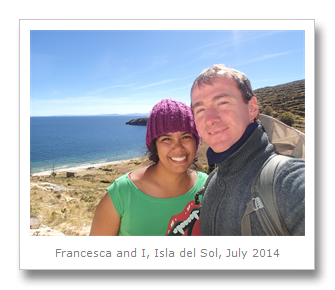
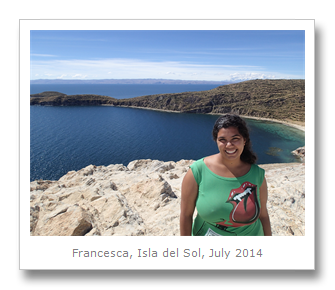
It was a lovely day, if not a bit chilly because of the altitude and the winds blowing across the lake. Many of the tourists were Westerners, but Bolivians were also visiting with their families. Our boat made it across the lake to the island about 3 hours away. The water was perfectly blue, and the numerous other islands we saw on the way really made the trip worthwhile as the scenery was beautiful.

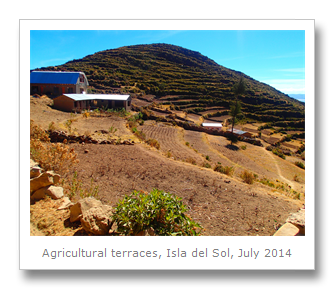
Once we got to the island, it was easy to see why the Incans had chosen it as their religious center. A rocky island, it was pretty easily defensible from attacks, yet the island and the ones around it were pretty good for farming too. The typical Incan farming terraces were present all over these islands, and we could even see many Incan ruins just from the boat!
We left our boat and headed straight to the museum located there. The museum contained many findings from a site located off shore underwater. Incense burners, urns, and other items decorated with pumas were left there by a pre-Incan culture called the Tiwanaku. These islands were actually inhabited even before this, back to 3000 BC.

We hiked up past incredible views across the bays where the local people were all busy with subsistence farming or selling useless shit to the tourists. We made it up (this was practice for our oncoming Inca Trail trek) to the first set of ruins. An Incan sanctuary, the Isla del Sol was considered the birthplace of the creator called Viracocha. A large sacred rock called the Titikala was credited as the origin of this God, and many Incan ruins surrounded it. We wandered around the Chinkana, a labyrinthine building which probably housed many of the religious leaders of the island. A temple of the sun was also here, and a sacred table that was possibly used for sacrifices. Not much sacred about it now though, as it was covered in tourist tat being sold by a local man.

There are no roads on the island, but the path up to the ruins and back was pretty well paved. We had bought some sandwiches on the island, and so we ate them once we got back to the boat. We waited around a little while for the other people to arrive, and then shipped out to the South of the island.

The main attraction on the South end of the island that we saw were a flight of Incan stairs that were still in use. Either side were some nice water fountains running next to the stairs, along with a pair of statues – an Incan warrior and his wife. The water irrigated Incan gardens which are still kept beautifully. Lots of children were running around trying to sell us tat, along with llamas and pigs wandering around at will. We wondered if their was a school on the island and if these children would ever go to one.

In the afternoon we re-boarded the boat with the other passengers. Many seemed to have stayed on the island, but we were glad to be heading back as one day is enough to see most everything. There were some more hikes, and some people had actually hiked all day from the North to the South across the island. We had heard it was quite a difficult hike, and cold too, so again, we were glad we took the boat!

We saw plenty of ducks on the way back, then, once we got back to Copacabana we rewarded ourselves with a beer whilst we watched the World Cup. We left on the morning of the 7th for Peru and Cusco. After easily crossing the border, we had to switch buses at Puno in Peru, heading towards the Inca Trail.

Tuesday, July 01, 2014

More Jungle Fun–Rurrenabaque


On the 30th June we boldly headed off to a small town in Northern Bolivia called Rurrenabaque (or Rurre for short – pronounced roo-ray). Rurre is a capital of a municipality but with just 8000 or so residents. It is located on the Beni river which lends it’s name to the entire Amazon region of Bolivia and is the gateway for tours to the Madidi National Park rainforest and tours to the wetland region known as the pampas.

To get to remote Rurre from La Paz, you can either take an 18 hour long bus journey which is apparently an uncomfortable hell across routes that are similar to Bolivia’s famous death road; or you can do as we did, and fly. Only a few airlines go this way, and we chose one that offered a 20-seater which flew us up and over the high peaks surrounding La Paz, across snow-capped peaks, and eventually, down over jungle-covered mountains to the tropical heat of Rurre.

We had already set up a tour with a jungle lodge that was the furthest into the jungle. 6 hours by boat. After being picked up at the airport we swung by the office, had a few of our questions answered, and were soon on our way, by boat, down the Beni and Tuichi rivers.

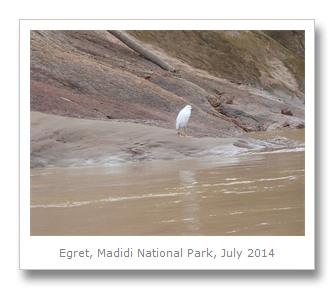
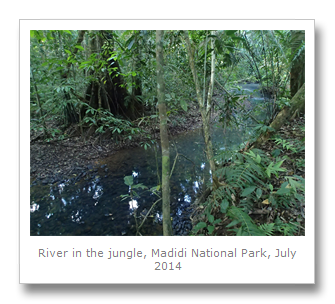
We had paid for 3 nights (4 days) and the boat trip there is certainly part of the experience. The murky brown water is home to many strange and wonderful fish, but it is the beautiful jungle scenery around you that really makes an impression. We did see animals, though, including turtles, egrets, herons, dwarf caiman, a large 2 meter long black caiman and even two families of capybara.

We stopped off for some lunch at a beach and Francesca and I immediately spotted a few different sets of clear and large jaguar footprints! Exciting! We saw tapir tracks, capybara tracks and jaguar tracks. The lunch was pretty good too – chicken and rice!

We arrived at the jungle lodge and wasted no time settling in. Accommodation was simply a tent with a mattress set up in the jungle under a protective wooden structure. Our tent was the furthest into the jungle, and one of the first things some of the guests who were there already told us over dinner, was that they had seen a jaguar a few days before on our side of the river, very near to the lodge. Awesome! And scary…we would have to walk ten minutes through the jungle to the tent after dark after every dinner time. Gulp!

The lodge we were at was called Berraco del Madidi, and it was clean and well run. The lodge had an excellent location and had excellent reviews online too. The food was great as well.

The next day we spent the morning on the boat, but did not see much, and in the afternoon, after lunch we went out with the owner of the lodge as our guide and were really lucky! At first, 5 minutes out of the camp we came across a giant anteater walking towards us on our trail. As soon as it saw us it ran off through the jungle and disappeared within 5 seconds – faster than I could get a photo!

Our next animal sighting was simply incredible – a pack of coatis (a kind of raccoon) were descending rapidly from the forest canopy, maybe 20 or 30 or more. I got a video, as they must have heard or smelt us and were spooked. They seemed to be raining down out of the trees, babies and all, and it was an extremely funny sight!

We next came across a pack of wild boar – our guide had an uncanny ability to hear them snuffling, snorting and aggressively clicking their teeth from over 50 meters away whilst we were walking. These creatures are a bit scary, as they have 8 inch razor sharp tusks and can be aggressive in large groups. We saw them, but as soon as they saw the three of us, they changed direction, as one, and disappeared within a few seconds. Phew!

We next spotted some Bolivian red howler monkeys high up in the canopy. Unwieldy monkeys, they have to move slowly so as not to fall, using their tails as a fifth limb to grip branches. They are the color of orangutans, and are pretty curious once they see us peering up at them. They were just a small family, and they were absolutely stunning.

We were pretty beat, and so we headed back for dinner. The other couple who were there told us of an ocelot they had seen! Lucky! We went to bed that night and slept really well in the tent. We heard various rustlings in the jungle around us, but were too tired to investigate properly.

Our second day was not quite as successful as the first, and we did not really see many animals. It was interesting to walk to a clay lick though, where animals, particularly peccaries, all hang out. We waited on top of a viewing platform but did not see anything at all. One group of boar were heard, but not seen, but we did manage to catch a fleeting glimpse of a beautiful trogon bird.

Back at the lodge for dinner and we spotted a large blue and green iguana, and we practiced shooting a bow and arrow at an orange (the fruit, not a lizard).

Another go on the boat did not yield up any further sightings, except some more jaguar prints, but the scenery was reward enough. That evening we did spot a fer-de-lance pit viper, which is the snake most responsible for snake bites in the region. They are rarely fatal but their venom is fast acting and can cause considerable damage to the body and even the memory.

A gecko made an appearance around the kitchen at dinner time, and after posing for several pictures, the harmless lizard was beaten to death by one of the staff members. This was totally unacceptable behavior for an eco-lodge, and they should be ashamed of themselves. We reported this matter to them afterwards, so hopefully it will not happen again.

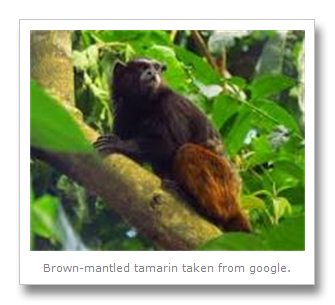
We hopped in a boat the next morning for a trip upstream to walk to a larger clay lick. We certainly had more luck that day! After spotting some larger howler monkeys we saw some smaller brown-mantled tamarins. These cute little brown and black monkeys are really inquisitive, and just stared at us for ages, maybe contemplating their own evolution. They looked like little bears, and they were certainly my favorite animal we had seen.

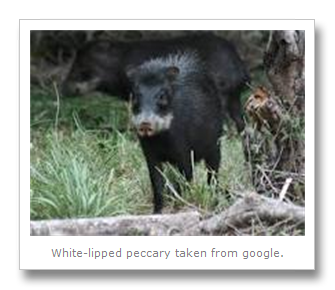
A great walk to the larger clay lick allowed us to see many more monkeys in the trees, and when we arrived at the clay lick we spotted two groups of wild boar, including white collared peccary, and the more aggressive white lipped peccaries. Luckily none of them charged, and they all disappeared after the males gave us some angry stares and grunts.

We made our way back to the boat after a good few hours out in the jungle, and after we had lunch and collected our things, we headed back to Rurre as it was our last day. On the 4 hour trip back, we saw capybaras and also a bunch of vultures hanging with a king vulture that has a really weird head. We stopped about an hour outside of Rurre where there was a final trail to walk. This one was about a half hour walk to another clay lick, but one that was a natural cliff face. On the cliff face were several pairs of red and blue macaws which is where they nested. It was great to see the birds flying around, and hanging out. Macaws hang out in pairs as they mate for life – and to see them happily free out in the jungle was so nice – much better than unnaturally in captivity.

Once we got back to Rurre we headed over to the hotel on the plaza and rested for the night. We had changed our flight back to be the 4th July, so we headed back to La Paz. Our flight was beset with turbulence once we got over the mountains, and we could see the pilots working really hard and going through their checklists to keep us level.

Thankfully we got to the airport OK, and we landed fine, and headed for some food. Madidi was a lovely National Park with some fine scenery and awesome animal spotting opportunities. The Berraco del Madidi lodge we chose was good but it definitely had some room for improvement.